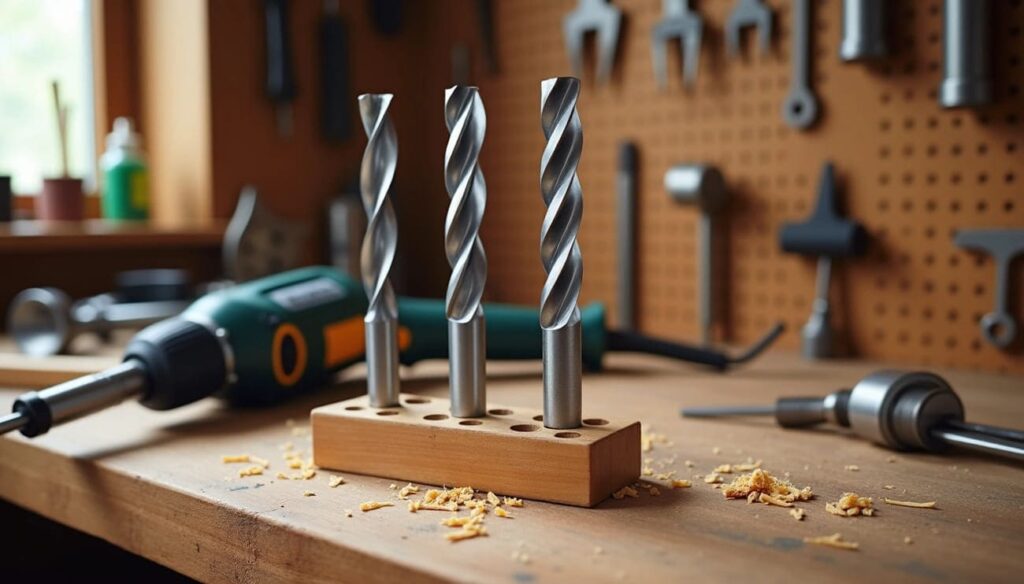
Choosing the right drill bit shank types for your projects can be tricky with so many options available. The shank fastens to the chuck of a revolving mandrel and comes in various designs. Each suits specific applications and drilling needs.
Taper shanks, straight shanks, and reduced shanks represent the most common configurations, with diameters ranging from 0.25 to 80 mm. Each type offers distinct advantages in terms of chuck compatibility, torque transmission, and drilling precision.
In this guide, we’ll explore the key differences between these three primary shank types. We’ll get into their design characteristics, compatibility requirements, and ideal applications.
What is a Drill Bit Shank?
The shank represents the non-cutting portion of a drill bit, located at the end opposite the tip. This component serves three critical functions during drilling operations.
First, it provides the mounting interface, allowing the bit to be securely attached to the drill’s chuck. Second, it transmits rotational force from the drill motor to the cutting end. Third, it ensures proper alignment, keeping the bit centered and stable throughout the drilling process.
In hole machining applications, the shank directly influences runout control and overall hole quality, making it especially important in precision metalworking tasks.
Overview of the 3 Main Drill Bit Shank Types
Drill bit shanks come in different shapes to meet various drilling needs and machine requirements. The main types are taper shank, straight shank, and reduced shank drills.
| Taper Shank | Straight Shank | Reduced Shank |
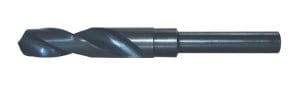
| DIN 345 – SOMTA HSS MTS Taper Shank Drills – Inch
|
KCT SOLID CARBIDE Straight Shank Jobber Drills
|
SOMTA HSS Reduced Shank Drills
|
|
|
|

Now let’s examine each type in detail.
Taper Shank Drill
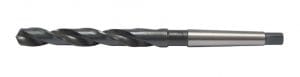 DIN 345 – SOMTA HSS MTS Taper Shank Drills – Inch
Taper shanks feature a conical shape that fits snugly into matching tapered bores in machine spindles. The Morse Taper system, developed over 150 years ago, is the most widely used standard, available in sizes MT0 through MT7.
Key Features
- Bits with diameters of 13 mm or more typically use taper shanks
- Taper measures approximately ⅝ inch per foot
- Transmits torque through friction across the entire contact surface (wedge principle)
- Self-tightening design eliminates the need for a chuck
- A tang at the end allows the bit to be ejected using a drift
Advantages
- High torque transmission with minimal slippage
- Superior accuracy and minimal runout
- Ideal for heavy-duty industrial drilling and large-diameter holes
Limitations
- Requires compatible machine spindles
- Not compatible with standard chucks or collets
- Specialized for industrial applications
Straight Shank Drill
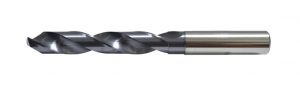
KCT SOLID CARBIDE Straight Shank Jobber Drills
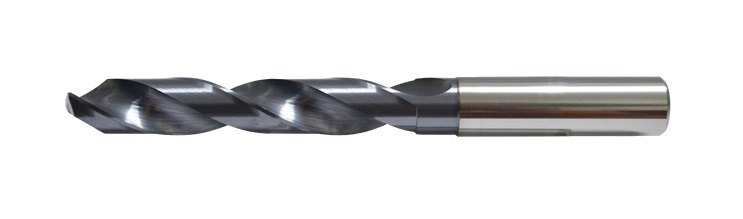
Straight shanks maintain a uniform cylindrical diameter along the entire shank, matching the cutting portion. This is the most commonly manufactured shank type, fitting securely into standard three-jaw drill chucks.
Straight shank drills made from solid carbide are especially suitable for CNC machining and heavy-duty machining applications due to their rigidity, wear resistance, and ability to maintain precision at high speeds.
Key Features
- Some variations have a slightly larger shank than the cutting portion for better grip
- Moderate torque transmission, dependent on chuck grip
- Accuracy depends on proper chuck alignment
Advantages
- Universal compatibility with hand drills and drill presses
- Widely available and cost-effective
- Suitable for general-purpose drilling in metal and plastics
- Solid carbide versions perform well in CNC machining and heavy-duty machining
Limitations
- May slip under heavy torque
- Requires careful chuck alignment for precision
Straight Shank Drill
 SOMTA HSS Reduced Shank Drills
Reduced shank bits combine a larger cutting diameter with a smaller shank diameter.
Key Features
- Cutting diameters range from 13mm to 50mm and 17/32” inch to 2” inch with a standard 1/2-inch shank
- Typically 6 inches long with a 3-inch flute length
- Uses standard three-jaw chucks, allowing larger holes without upgrading the chuck
Advantages
- Enables drilling larger holes with standard-sized chucks
- Versatile for metal fabrication and maintenance operations
- Suitable for machines with limited spindle capacity
Limitations
- Slightly less rigid than taper shanks
- Torque transmission depends on chuck strength
Premium Quality Cutting Tools at Competitive Prices
Our cutting tools are expertly manufactured and rigorously tested to enhance machining performance and operational savings.
Choosing the Right Shank Type for Your Project
Matching shank types to project requirements prevents tool damage and ensures optimal drilling performance. Several factors determine the appropriate shank selection for specific applications.
Material Compatibility
Metal Drilling: Straight and reduced shanks excel in metalworking applications, withstanding the high pressures and temperatures encountered when drilling steel, aluminum, and other alloys. The cylindrical design distributes clamping forces evenly across the chuck jaws. Solid carbide straight shank drills are particularly effective for CNC machining and heavy-duty machining of harder materials.
Compatibility of the Drill Machine
Chuck type dictates shank selection. Standard three-jaw chucks accommodate straight and reduced shanks, while taper shanks require machine spindles with matching tapered bores. Hand drills typically feature 10 mm or 13 mm chucks, limiting bit size. Drill presses accommodate larger bits through tapered spindles.
Hole Size and Depth Requirements
Reduced shanks enable larger holes in standard chucks, with cutting diameters reaching 1-1/2 inches on 1/2-inch shanks. Taper shanks suit deep drilling operations where extended length and rigidity matter.
Torque and Power Needs
High-torque applications demand taper shanks for secure torque transmission. Straight shanks suffice for general-purpose work but may slip under heavy loads.
Project-Specific Applications
Project complexity guides the Shank choice. Heavy-duty construction demands taper shanks for power and stability.
Common Applications and Use Cases
When To Use Taper Shank Drill Bits?
Heavy-duty industrial operations demand taper shank drill bits for their superior torque transmission capabilities. Automobile manufacturing, machine tool production, and CNC-VMC machine shops rely on these bits for drilling steel, cast steel, and gray cast iron.
Key applications include:
- Heavy-duty drill presses: Superior torque transmission prevents chuck slippage when creating larger diameter holes
- Lathe operations: Drill sleeves enable taper shank tools to work with lathe-equipped adapters
- High-torque drilling: Industrial applications requiring maximum power transfer
When To Use Straight Shank Drill Bits?
Straight shank drill bits dominate general-purpose drilling across the widest range of applications. Their universal compatibility with three-jaw chucks makes them the preferred choice for diverse materials and standard operations. Solid carbide straight shank drills are especially suitable for CNC machining and heavy-duty machining where high precision and wear resistance are required.
Common applications include:
- Metal and plastic drilling: Standard 118-degree points handle multiple materials effectively
- Wire gauge operations: Precisely sized holes for tapping operations
- DIY and construction projects: Universal chuck compatibility simplifies tool selection
- Multi-material machining: Stainless steel, cast iron, and aluminum drilling capabilities
- CNC machining and heavy-duty machining with solid carbide drills
When To Use Reduced Shank Drill Bits?
Reduced shank drill bits solve the fundamental problem of drilling larger holes with standard-sized chucks. Standard drill presses and handheld drills with smaller chucks benefit from reduced shank configurations for expanded drilling capacity.
Primary applications include:
- Metal fabrication: Effective hole creation in cast iron and aluminum using 1/2-inch reduced shanks
- Maintenance operations: Drilling larger holes without chuck upgrades
- Limited equipment scenarios: Maximizing hole size capability with existing tools
Comparison Table: Drill Bit Shank Types
| Attribute | Taper Shank | Straight Shank | Reduced Shank |
| Design | Conical/tapered shape that fits into matching tapered bores | Cylindrical profile with uniform diameter throughout | Larger cutting diameter combined with smaller shank diameter |
| Size Range | Morse Taper MT0 (9.045 mm) to MT5 (44.399 mm); typically for bits 13mm+ diameter | Uniform diameter matching the cutting portion; 0.25 to 80 mm range | Cutting diameter: 9/16″ to 1-1/2″; Standard shank: 1/2″ |
| Mounting Method | Mounts directly into machine spindles without chucks; self-locking taper | Requires three-jaw drill chucks for clamping | Requires three-jaw drill chucks (same as straight shank) |
| Chuck Compatibility | Not compatible with standard chucks or collets | Compatible with standard three-jaw chucks | Compatible with standard three-jaw chucks; enables larger holes in smaller chucks |
| Torque Transmission | High torque transmission through friction across entire contact surface; wedge principle creates massive frictional grip | Limited torque transmission; potential for slipping under heavy loads | Limited torque transmission due to cylindrical shank (similar to straight shank) |
| Drilling Precision | Superior accuracy with minimal runout; no intermediate components; spins true to spindle axis | Stable, concentric rotation but requires careful alignment | Not specifically mentioned |
| Grip Mechanism | Self-tightening wedging action; drilling force prevents slippage | Chuck jaws close around round surface | Chuck jaws close around round surface |
| Length Specifications | Not specifically mentioned | Not specifically mentioned | 6 inches long with 3-inch flute length |
| Cost & Availability | Specialized for industrial applications; simple to manufacture on lathes | Most manufactured type; widespread availability; lower costs | Moderate pricing; balance of versatility |
| Common Applications | Heavy-duty operations, automobile manufacturing, machine tool production, CNC-VMC shops, large diameter holes, high-torque drilling | General-purpose drilling, metal, plastic, DIY projects, construction, wire gage holes for tapping | Limited chuck sizes, standard drill presses with smaller chucks drilling larger holes, metal fabrication |
| Material Compatibility | Steel, cast steel, gray cast iron | Metal (stainless steel, cast iron, aluminum), plastic | Metal (cast iron, aluminum) |
| Best For | High-torque applications, deep drilling operations requiring extended length and rigidity, heavy-duty drill presses | Widest range of applications, universal compatibility, general-purpose work | Drilling larger holes with standard-sized chucks |
| Special Features | Tang at end for ejection using drift; approximately ⅝ inch per foot taper | Most common type; 118-degree points standard | Also known as blacksmith’s drills or Silver & Deming drills |
Conclusion
Choosing the right drill bit shank is simple with Kota Cutting Tools. As one of the leading cutting tools manufacturer in Malaysia, we provide a wide range of high-quality tools to meet your drilling needs. Straight shanks are ideal for general-purpose drilling and work with standard chucks. Taper shanks are perfect when you need maximum torque and precision for heavy-duty metalworking. Reduced shanks let you drill larger holes without having to upgrade your chuck.
The best choice for your project depends on the material, hole size, and available equipment. Considering these aspects will help you select the drill bit shank that fits your specific drilling requirements.
Contact Kota Cutting Tools for expert guidance, and our team will help you find the perfect solution for your project.
Acquire Premium Quality Cutting Tools at Exceptional Prices with Kota Cutting Tools
Our cutting tools are expertly manufactured and rigorously tested by our technical team to enhance your machining performance and take your business to new heights.
FAQ
What makes straight shank drill bits different from taper shank drill bits?
Straight shank drill bits have a uniform cylindrical shape and are clamped into a drill chuck, which is suitable for general-purpose and light to medium-duty drilling. Taper shank drill bits have a conical shape that fits directly into a machine spindle without a chuck, allowing higher torque transmission and better stability for heavy-duty industrial applications.
What are the drill bit shank types available at Kota Cutting Tools?
Kota Cutting Tools offers all three primary drill bit shank types, including straight shanks (cylindrical design for standard chucks), taper shanks (conical design for machine spindles), and reduced shanks (larger cutting diameter with smaller shank) from different brands, such as SOMTA and KCT.
You can find drill bits made from different materials and compositions, including Solid Carbide, HSS (High-Speed Steel), HSS-Cobalt, and TCT (Tungsten Carbide Tipped) for your project needs.
Why would I choose a reduced shank drill bit over a standard straight shank?
Reduced shank drill bits allow you to drill larger diameter holes using a standard-sized chuck. With a typical 1/2-inch shank supporting cutting diameters up to 1-1/2 inches, they’re perfect for maintenance work and situations where you need larger holes but don’t want to upgrade your drill chuck capacity.
Why do some drill bits have a tang on the shank?
Some drill bits, especially taper shank bits, have a tang at the end of the shank to allow easy ejection from the spindle after drilling. It also helps prevent the bit from slipping while transmitting high torque.
When should I use taper shank drills instead of straight shank drills?
Use taper shank drills for heavy-duty industrial applications requiring high torque transmission, such as drilling large diameter holes in steel, cast iron, or other hard materials. They’re essential for CNC machining, automobile manufacturing, and situations where drilling precision and minimal runout are critical. Straight shank drills work better for general-purpose tasks and smaller holes.